The perfect Cartagena and Rosario Islands 3 day itinerary
Updated: Sep 9
Cartagena is perhaps one of the most popular destinations in Colombia. The city is famous for its beautiful colonial streets, protective walls and joyful atmosphere. The Rosario Islands are a caribbean archipielago with pristine waters not far from Cartagena. In this post I share with you my Cartagena and Rosario Islands 3 day itinerary so that you can experience history, color, beautiful beaches, snorkel and even fluorescent plankton all in one trip.

Day 1: Cartagena
Cartagena is a city located in the caribbean coast of Colombia. It is one of the oldest and perhaps one of the most fascinating cities in South America. It used to be one of the Spanish Empire's most important ports and because of its immense wealth, the city was repeatedly targeted by pirates, including the infamous Sir Francis Drake. As a response the Spanish built massive defensive walls and fortresses that still surround the Old Town today. The walls stretch for several kilometers, but I find that walking along a section of them is a good first activity to do.


After visiting the walls I suggest you walk through the historic center, where you'll find colorful colonial streets and beautiful churches.

The city also has nice cafés and boutiques to visit as well.

I would not recommend going to the beach in Cartagena. Instead, I would save that for your second day in the Rosario Islands, where the water is cleaner and the beaches are less crowded.
Day 2: Rosario Islands
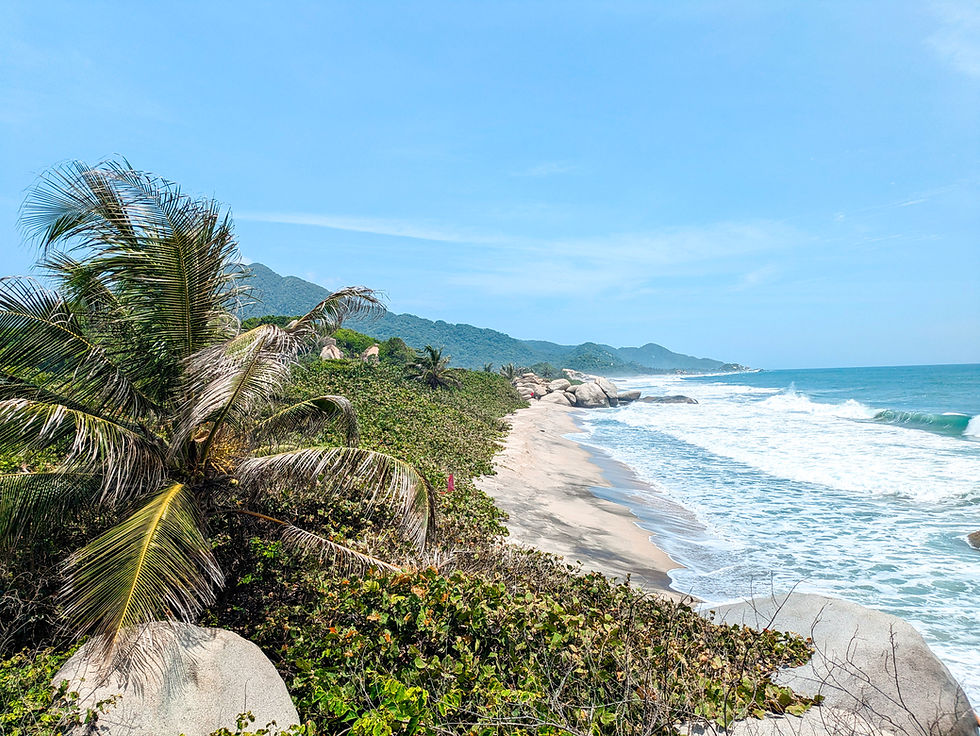
On day two you will visit the Rosario Islands.The Rosario Islands are a protected caribbean archipelago made up of around 27 islands located about an hour by boat from Cartagena. They are part of a national park known for its coral reefs, clear turquoise water, and marine biodiversity. I recommend you take a guided tour. The tour we took included visits to five different islands, snorkeling, and bioluminescent plankton. I personally found the tour very complete and good value for what we paid. You can find the link here.
You will spend a part of the day on a boat visiting the different islands, with some occasional stops.


Unfortunately, I don’t have any high quality photos of the snorkeling activity, because it is hard to take pictures with a phone underwater, and we were also busy swimming as the current was slowly taking us further and further away from the boat. But honestly, seeing the little fish swimming around is an incredible experience. I recommend you buy a waterproof phone pouch like this one to keep your phone and valuables safe. That also allows you to record videos underwater and avoid loosing your phone.


Also make sure you apply sunscreen every couple of hours, it's super important. Since the day was rather cloudy we thought applying sunscreen once is the morning would be enough. Big mistake, because my boyfriend got severely sunburned and had a high fever. The sunburn left him with back pain for days. So don't forget the sunscreen.
After the Rosario Islands you will also stop at the island of Barú for lunch and the photoplankton activity will begin there as well.

Bioluminescent plankton, or photoplankton, are microscopic marine organisms that produce light through a natural chemical reaction inside their bodies. When the water is disturbed by movement such as swimming or waves, they emit a blue glow that can be seen at night in certain coastal areas. This phenomenon is rare and depends on specific conditions. The Enchanted Lagoon in Barú is one of the places you can see the phenomenon take place.
The light is not very strong, but when you are on the boat at full speed and you touch the water with your hands, you can see it glow. It was honestly a very unique experience for us. Also, note that if you try taking pictures with your phone, you won’t be able to capture anything, so they offer a photography service with a professional camera. I think we paid around 70,000 COP for the two of us.


Day 3: San Felipe Castle and departure
On your third and last day I recommend you visit San Felipe Castle. San Felipe de Barajas Castle is one of the most important military structures in Cartagena. Built by the Spanish in the 17th century, the castle was, like the walls, designed to defend the city from pirate attacks and foreign invasions. To go up you will have to walk a bit so I would suggest you go in the morning to avoid peak heat.


After that you can directly head to the airport or explore the city a bit more if your flight is later in the afternoon.
I hope you have found this guide useful!


Comments