Perfect 8 day Morocco itinerary
Updated: Sep 9
Morocco is a beautiful and complex country. Its culture is a mixture of Arab and Amazigh influences, with incredible landscapes ranging from the Atlas Mountains to the Sahara Desert and the Atlantic and Mediterranean coasts.
Here I present my one week Morocco itinerary. As you might expect, one week is simply not enough to fully explore a whole country, but the itinerary I have put together allows you to discover two of the most iconic cities in Morocco, Fez and Marrakech. It also includes a visit to the Sahara Desert, time to explore historical sites such as Aït Benhaddou, and an opportunity to experience the beauty of the Atlas Mountains in the village of Imlil.
Before explaining the itinerary in detail, I would like to provide some historical and cultural context, as well as a few travel tips that can help make your trip as comfortable and enjoyable as possible.

Culture and religion
About 99% of people in Morocco are Muslim, and religion plays an important role in society and everyday life. Most Moroccans follow Islam, and religious traditions influence daily rhythms, social customs, and many aspects of public life.
Like in many Muslim-majority countries, you will hear the five daily calls to prayer, known as the adhan, coming from mosques throughout the city. In places like Marrakech, Fez, or smaller towns, the sound of the call to prayer echoing across the streets can be a very striking experience, especially for those who are not used to it. I personally find it fascinating.
Religion also shapes certain social norms. For example, modest clothing is generally more common, alcohol is less visible than in many Western countries, and religious holidays such as Ramadan strongly influence daily life, with many people fasting from sunrise to sunset during that period.
Like in any culture, you will meet incredibly kind, generous, and welcoming people, but you may also encounter dishonest individuals, especially in busy tourist areas where scams targeting visitors are more common. This is not unique to Morocco and can happen in many popular travel destinations.
Amazigh culture
The Amazigh, also known as Berbers, are the Indigenous peoples of North Africa, present in the region long before the Arab expansions of the 7th century. Today, the population of Morocco is largely a mixture of Arab and Amazigh heritage, although many people primarily identify with one culture or the other.
Large Amazigh communities still live throughout the country, especially in the Atlas Mountains and in desert regions such as the Sahara Desert. However, Amazigh culture is not limited to these areas. It is present across much of Morocco and is an important part of the country’s identity.
The Amazigh have their own languages, commonly referred to as Amazigh or Tamazight languages. These languages are completely different from Arabic and belong to the Afro-Asiatic language family. They are traditionally written using the Tifinagh alphabet, which you can now see on many official signs in Morocco alongside Arabic. In fact, Tamazight was recognized as an official language of Morocco in 2011.
Today, the vast majority of Amazigh people are Muslim, like most of the Moroccan population. Before the spread of Islam, Amazigh societies practiced a variety of belief systems, including local polytheistic traditions and, in some regions, Judaism and Christianity.
Amazigh culture is incredibly rich and diverse. It is known for its beautiful and symbolic carpets, traditional music, and regional cuisines. We personally experienced great hospitality and generosity from Amazigh communities.

Amazigh carpets
Basic Darija
When traveling to any country, it is always a sign of respect to learn a few words in the local language. In Morocco, many people speak Arabic, but the everyday spoken language is Moroccan Arabic, also called Darija. Darija is quite different from Modern Standard Arabic and includes influences from Amazigh languages, as well as many words borrowed from French and sometimes Spanish. Because of these differences, it can sometimes be difficult for speakers of other Arabic dialects to fully understand it.
Learning a few simple words can go a long way and is often appreciated.
Hello: Salam
Thank you: Shukran
Please: Afak
Goodbye: Bslama
How much?: Bshhal?
Basic Tamazight
Tamazight has several regional varieties in Morocco, so pronunciation and spelling can vary slightly depending on where you are. Even so, simple words like Azul and Tanemmirt are widely recognized and appreciated.
Hello: Azul
Thank you: Tanemmirt
Safety
If I am being honest, I did not entirely feel safe throughout my visit to Morocco, even though we were a heterosexual couple traveling together. Personally, I would probably not choose to travel solo there as a woman.
I would strongly advise being cautious with apps like inDrive. Even though it can be cheaper than a taxi, it operates in a legal gray area in Morocco and is not officially authorized in many cities. Because of that, rides can sometimes be stressful. In our case, we had a very bad experience with a driver who seemed sketchy and asked us for extra money during the ride. Using official taxis or asking your accommodation to arrange transport is often safer.
Another thing to watch out for is so-called fake guides. In busy tourist areas, especially in cities like Marrakech or Fez, someone might approach you and offer to guide you to a place you are looking for. They may seem friendly and helpful, but at the end they will often demand payment. You can also encounter very persistent sellers in the souks. The easiest way to deal with this is to politely say thank you and keep walking without engaging too much.
In places like Jemaa el-Fna and the surrounding markets, you should also stay alert for pickpockets or small scams, which are common in many busy tourist areas around the world. While Morocco generally has a relatively low rate of serious violent crime compared with many countries, I still felt the need to stay alert most of the time, especially in crowded areas.
That said, many travelers do have positive and safe experiences in Morocco. Being aware of common scams, using official transport, and staying confident and cautious in busy areas can make the trip much smoother.
If you encounter any problem, you can always dial the number 19 to call the Police.
Animal welfare in Morocco
Even if I weren’t vegan, I would be cautious about consuming animal products in Morocco. Unfortunately, Morocco is one of the countries where animal welfare regulations are limited and enforcement is often weak. This means animals used for tourism, transport, or food are not always treated well.
In cities like Marrakech, in the Jemaa el-Fna square, you will often see endangered Barbary macaques chained up or kept in small cages, sometimes dressed in clothes so tourists can take photos with them. These monkeys are wild animals that are frequently taken from their natural habitats and kept in stressful conditions. You will also find snake charmers with cobras or other snakes that are used for performances. If you do not want to support this type of activity, it is best to avoid taking photos with the animals and avoid giving money.
Horses and camels are often used for tourist rides. In many places, you'll see visible marks or wounds, and some animals spend long hours working with limited rest, water, or space. Since these animals are primarily used for tourists, refusing camel or horse rides can make a difference and helps reduce demand for these practices.
In Fez and Marrakech, especially in the souks, we also saw chickens and hens kept in small cages. In many traditional markets, poultry is kept alive until it is sold or slaughtered, which can raise both animal welfare and hygiene concerns. For that reason, I would suggest avoiding animal products in Morocco. Even in some stores you'll find real fur being sold. This makes me wonder the conditions in which these animals lived before being slaughtered.
The good news is that Moroccan cuisine actually makes it very easy to eat plant-based. Many traditional dishes are naturally vegan or can easily be made vegan, such as vegetable tagine, vegetable couscous, lentil dishes like harira, msemen, or even certain versions of pastilla made with vegetables instead of meat. The food is delicious, filling, and widely available.
Being mindful about the activities you participate in and the food you choose can help you enjoy Morocco while avoiding practices that may harm animals.
Prices
Morocco is generally a relatively affordable country to travel in. In many local restaurants, you can usually eat for around 60 to 100 MAD (about 6 to 10 €) for a single dish, or around 110 to 140 MAD (about 11 to 14 €) for a menu that includes a starter, a main dish, and sometimes dessert.
For our 8 day trip, including accommodation, guided tours, eating out, and souvenirs, we spent about 600 to 700 € per person, excluding flights. This budget allowed us to travel comfortably without choosing particularly luxurious options. If you prefer more upscale accommodation or plan to eat in higher-end restaurants, you may want to increase your budget a bit.
Make sure to bring cash with you! Very few places accept credit cards. Exchange houses in cities usually have the best rates.
Another important thing to know is that Morocco has a strong negotiation culture. In the souks (markets), especially in cities like Marrakech or Fez, the first price you are given is often not the final one. It is common to politely negotiate, and vendors usually expect it. Unless you already feel that the price is fair, you can always ask for a discount. Bargaining is part of the experience and, when done respectfully, it is generally seen as normal rather than rude.
When to visit Morocco
When visiting Morocco I would avoid the summer months ( June to August ) since it tends to get really really hot. We had a rather chilly weather when we visited in February, but honestly I think it is perfect.
Essentials you should not travel without
A SIM card or eSIM. We used Nomad esim and it worked wonderfully, we even had cellular data in the desert. Prices are really good and I can only recommend it. You can use my promo code TBLVAHOGWJKA to get $5 off your first purchase.
A filtering water bottle. Tap water is not drinkable in Morocco. To avoid having to buy tons plastic bottles, I would recommend you use a water filter or filtering water bottle. We personally used an Öko water bottle.
A jacket. Even though many of us think of the desert when we think about Morocco, the country also has very high mountains. The Atlas Mountains reach elevations of more than 4,000 meters, and temperatures there can be much colder than in the cities or in the desert. If you are planning on visiting mountain areas such as Imlil, it is a good idea to bring a jacket and warm clothes, even if you are traveling in spring or fall. In fact, it even snowed when we visited, which was something we definitely did not expect before arriving in Morocco.
Sunscreen, especially during the warmer months
Modest clothing. Like I said before, Morocco is a Muslim-majority country so dressing appropriately is a sign of respect
From Fez to Marrakech: Morocco perfect one week itinerary
Day 1 : Arrival to Fez
Fez is one of the oldest and most historically rich cities in Morocco. Very early on, Fez became a major hub of trade, culture, and learning. Its location made it a key crossroads between sub-Saharan Africa, the Middle East, and Europe.
During the Middle Ages, Fez became the capital of several Moroccan dynasties. This period is often seen as a golden age for the city, when art, architecture, and education flourished. The historic center, Fes el-Bali, dates back over a thousand years and is now a UNESCO World Heritage site.
On your first day, I suggest arriving calmly and settling into your hotel. Staying inside the medina (the old city) of Fez is a great option because you will be within walking distance of most of the main attractions. The medina can be a bit confusing at first. For that reason, I would recommend arriving during the daytime, as some of the narrow alleys can feel quite dark and sketchy at night.
Once you are settled, you can go out for dinner and try some local food. During our stay, we completely fell in love with a small restaurant near where we were staying called Sodfa. We ended up eating there almost every day while we were in Fez because the food was so good.
I highly recommend trying their vegetarian tagine as well as their vegetarian couscous. Both dishes were absolutely delicious and packed with flavor. Moroccan cuisine uses many spices and slow cooking techniques, which makes even simple vegetable dishes incredibly rich and satisfying.

Delicious vegetarian tagine and vegetarian couscous at Sodfa in Fez

Harira soup and Moroccan salads at Sodfa in Fez
Day 2 : Fez
One of the most iconic things to see in Fez are its historic gates, known as babs in Arabic. These monumental doors mark the entrances to the old city and were originally built as part of the defensive walls surrounding the medina.
One of the most famous is Bab Boujloud, often called the Blue Gate. It is one of the main entrances to the medina and is covered in beautiful blue and green mosaic tiles. It is also one of the liveliest areas of the city, with many restaurants, cafés, and shops nearby

Bab Boujloud, view from outside the medina

Bab Boujloud, view from inside the medina
.
Another gate worth visiting is Bab Mahrouk, located on the western side of the medina. It is less crowded than Bab Boujloud, but still very beautiful and historically important.

Bab Mahrouk
I would also recommend simply walking around the city and the souks (markets).

Souks and streets in Fez
Fez is a particularly historic city, and you will find many remarkable cultural and historical sites throughout the medina. Among them are the madrasas, which are traditional Islamic schools that were not only places of learning but also architectural masterpieces, often decorated with intricate tiles, wood carvings, and courtyards.
You can visit beautiful examples such as Al-Attarine Madrasa or Bou Inania Madrasa, both of which showcase the richness of Moroccan craftsmanship and the importance of education in Islamic history.
Fez is also home to one of the oldest existing university, University of al-Qarawiyyin, founded in the 9th century.

Bou Inania Madrasa in Fez

Al-Attarine Madrasa in Fez
Many people like to visit the tanneries in Fez, but we personally found it a rather unpleasant experience.
Day 3 : Fez to Merzouga
For the next three days, I recommend booking a tour. Traveling to the Sahara Desert on your own can be complicated and can quickly become stressful.
Tours are generally very accessible in Morocco and often start at quite reasonable prices. Most of them include transportation, accommodation, and several meals. We paid around 200€ per person for the whole tour, luxury tent included for the first night. We found the price really fair since it included two days of accommodation, two breakfasts and two dinners.
We personally loved our tour. It was very complete and honestly great value for the money we paid. The itinerary was well organized, we got to see a wide variety of places, and everything felt smooth from start to finish. The people we met along the way were all very kind, and the whole experience was unforgettable.
On your first day, you will be going to Merzouga in the Sahara Desert. One of the first stops of the tour is the Azrou Cedar Forest. There, you can see monkeys, specifically Barbary macaques. They live in the wild, but many of them have become used to humans because tourists often feed them. While it can be a memorable experience to see them up close, feeding wildlife can disrupt their natural behavior, make them dependent on humans. If you visit, it is best to observe them from a distance and avoid feeding or touching them.

Monkey on the Azrou Cedar Forest
Expect to eat a lot of tagine during your tour. We honestly had no problem because moroccan food is absolutely delicious.

Vegetarian tagine
The scenery on your way to Merzouga is absolutely stunning. We thought Morocco was only desert and were surprised to find such a lush scenery.

We also saw some beautiful places along the way, such as the Ziz Valley, which is a stunning natural oasis. The valley follows the Ziz River and is lined with thousands of date palm trees.
Once you get to your camp near Merzouga, I would recommend asking if you can do a quad ride instead of riding camels. You will usually have to pay an extra 600 to 650 MAD for two people, but in our experience, it was absolutely worth it.

Near Merzouga, you will find the Erg Chebbi sand dunes, one of the most impressive desert landscapes in Morocco. The dunes can reach up to 150 meters high, and the scenery feels truly otherworldly.

After that you'll head to the camp where you will spend the night. You can usually choose between a regular tent and a luxury tent. We chose the latter since the upgrade was not that costly.

Luxury camp near Merzouga

Inside of luxury tent
The luxury tents were super well-equipped and comfortable with bathroom, shower, queen-size bed ... all you need really. Unluckily for us, when we stayed there the weather was extremely cloudy, but on a normal night you should be able to see the milky way in the sky.
Day 4 : Merzouga to Ouarzazate
On our second day of the tour, you will be heading to the city of Ouarzazate. On your way, you will stop at the Todra Gorge, which is a river canyon carved over time by the Todra River as it cuts through rock in the Atlas region of Morocco.

Todra Gorge

The view from where we had lunch
After that, if your guide is as kind as ours (Mohamed), you may stop at a women’s rug cooperative, where they will explain the entire process of how the rugs are made using a loom. You’ll find traditional wool rugs, as well as rugs made from cactus fibers. The colors and motifs are simply beautiful.


Women's rug cooperative
You'll additionally pass across iconic kasbahs, which are traditional fortified earthen buildings made from mudbrick, like those in Tinghir. Some kasbahs are still inhabited today.
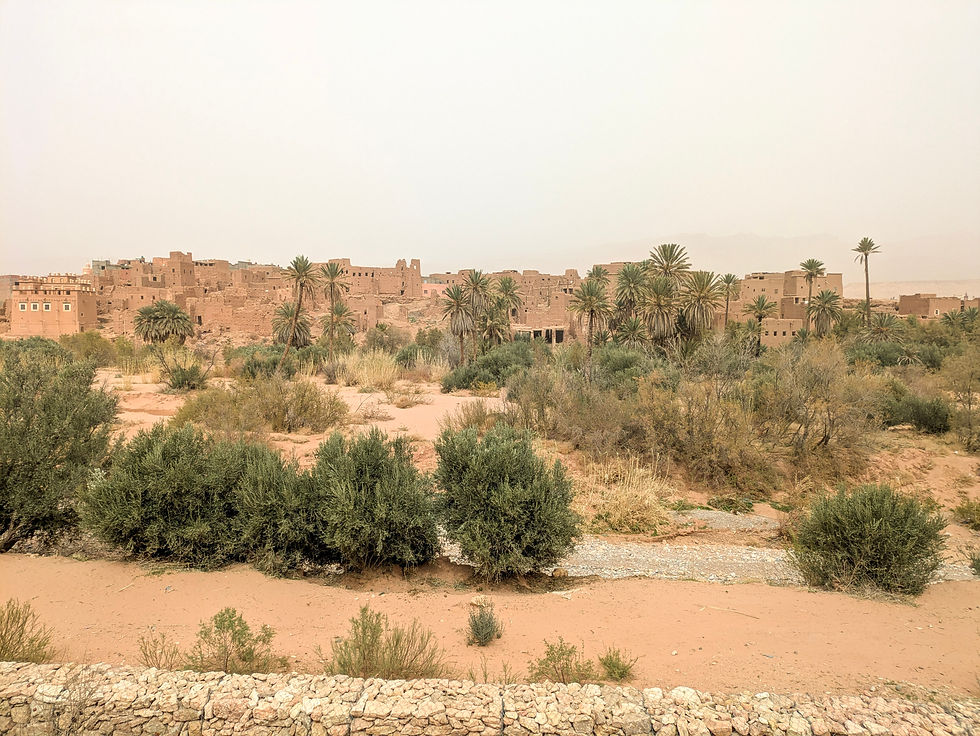
Tinghir
You will also stop at a women’s cooperative for rose water and rose oil. That night, you will sleep at a nice hotel in Ouarzazate.
Day 5 : Ouarzazate to Marrakech
On your third and final day of the tour you will visit Atlas Studios, which is one of the largest film studios in the world. A lot of major productions were filmed here, including scenes from Gladiator, The Mummy and Game of Thrones. If you’re into cinema, visiting the sets is probably worth it. Since we are actually not that interested in movies, we actually skipped it.
After that, you will visit Aït Benhaddou, one of the most famous historic villages in Morocco and a UNESCO World Heritage Site. Aït Benhaddou was built for trade. Caravans crossing the Sahara used this route to transport salt, gold, spices, and textiles.

Aït Benhaddou

View to the desert from Aït Benhaddou
After Aït Benhaddou you'll finish your tour in Marrakech.
Day 6 : Marrakech
Marrakech is one of the most iconic cities in Morocco. At first, the city might feel very intense, with motorcycles and people everywhere. We felt a bit insecure at first, but then got used to the city’s dynamic. I personally found Marrakech nicer overall and generally safer than Fez.
Like in most cities in Morocco, the main thing to do is visit the medina as well as the souks. Marrakech is no different. In the souks, you will encounter a wide variety of fresh spices as well as artisanal craftsmanship.

Moroccan ceramics in Marrakech

More couscous, because it's delicious
A must-do in Morocco is staying at a riad. A riad is a traditional Moroccan house built around a central courtyard. Most riads today are converted into small boutique hotels and they are often times cheaper than regular hotels or Aibnbs.

The riad we stayed at
Another thing to do in Marrakech is visit Jemaa el-Fna, which is the city’s main square. I would do so with caution, as we were shocked to see chained monkeys kept in cages, as well as the well-known snake charmers.
Fortunately, tourists are becoming less interested in these practices, and hopefully the vendors will shift toward other activities. To avoid supporting this, it’s best not to take photos or engage with them.
Day 7 : Marrakech - Atlas
Morocco wouldn’t be the Morocco without the Atlas Mountains, and luckily, they are not far from Marrakech. We took a day tour to the mountains, specifically to the village of Imlil. Like many mountain villages in Morocco, the area is home to Amazigh communities.


Mountains and Amazigh village
The tour usually stops for breakfast at a women’s argan oil cooperative. Argan oil is one of the country’s most iconic products, traditionally made from the nuts of the argan tree, which grows almost exclusively in the southwest of Morocco. Today, many women’s cooperatives continue to produce it using traditional methods.

Women making argan oil the traditional way
After that you will head to the village of Imil. The day then includes a hike of about 1 to 1.5 hours, with beautiful views of the surrounding mountains. You’ll stop for a traditional Amazigh lunch before heading back to Marrakech. It’s a simple but rewarding experience, and one I would definitely recommend.


The photos really speak for themselves
Day 8 : Marrakech
For your last day in Marrakech, I recommend visiting the Ben Youssef Madrasa, an Islamic college founded in the 14th century.


I hope this guide helps you during your trip to Morocco!



Me encantó, súper completo el plan y aprendí un montón. Gracias por compartirlo 😊